
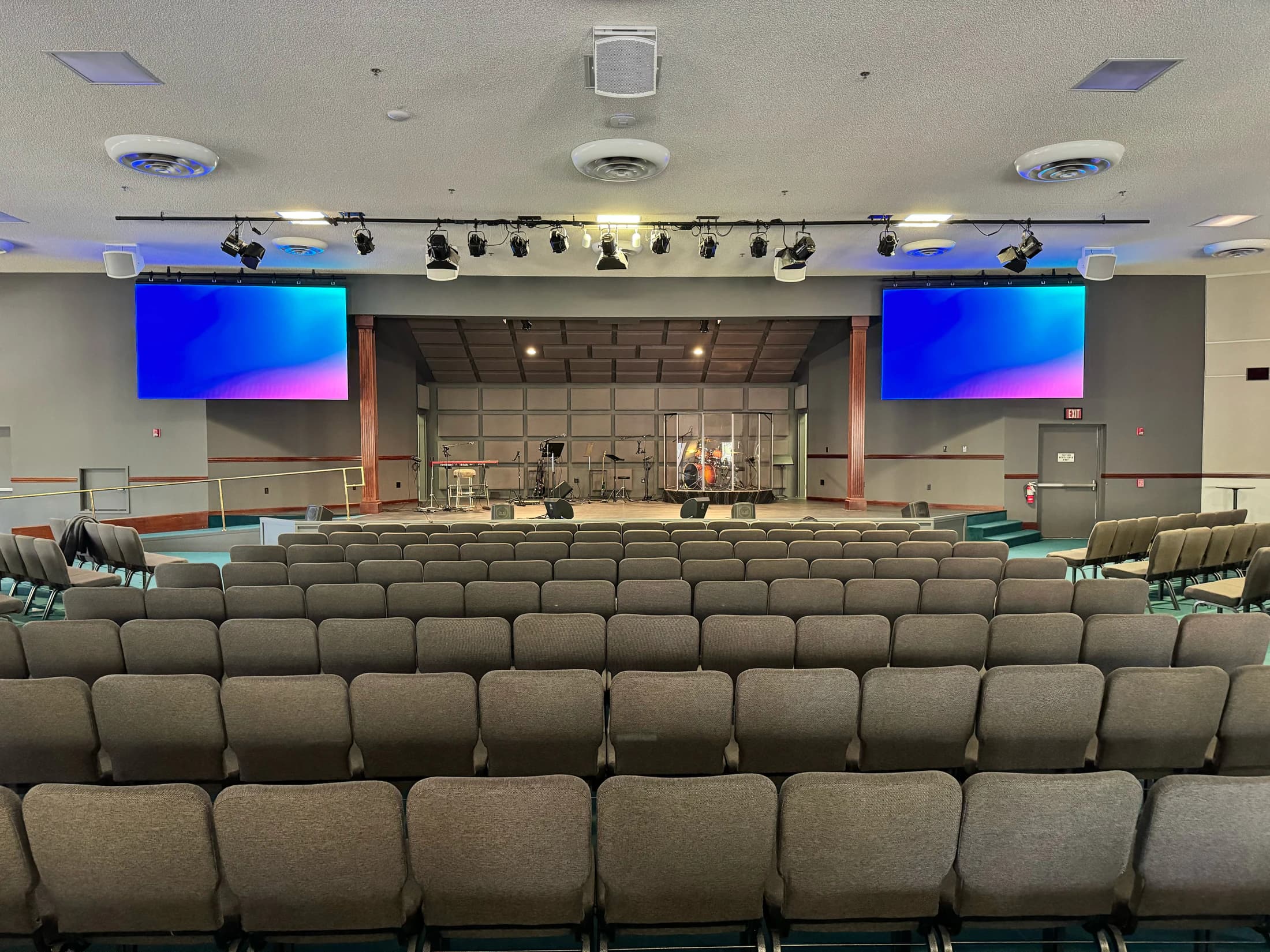
The honest answer to “LED or projector” is that it depends on what is going wrong. A church whose lyrics wash out under stage lighting has a different problem from a church whose back rows cannot read the screen, and a different one again from a church whose display looks fine in the room but poor on the livestream.
Those three complaints often arrive under the same description: “people can’t see the screen.” They do not all lead to the same purchase.
A brighter display in the wrong position solves nothing. Neither does a bigger one in the wrong room.
Start here
Diagnose the symptom before choosing the display
Before comparing a projector with an LED screen, get specific about when the current system fails. The timing usually identifies the cause.
It fails when the lights come up
Readable in a dark room, washed out once stage lighting is working. Review light falling on the screen, projector output, screen material, and image settings. The existing system may be at its practical limit, but that needs checking.
It fails in specific seats
Fine down the center, unreadable from the sides or the back. This is a geometry problem involving viewing angle, distance, or sightlines, not an output problem.
It fails on camera
Acceptable in the room, poor on the stream. Contrast, banding, and refresh behavior are the usual causes.
It fails on Tuesdays
Lamps, filters, alignment drift, and bulbs sourced at short notice. This is an operating-cost problem more than an image problem.
Changing display technology can help with brightness, but it is not an automatic cure. LED can also show moiré, flicker, or banding on camera. Test the display, processor, camera settings, and intended shots together. Sightline problems require a placement or layout decision, whether the display is LED or projection.
The real differences
How the two actually behave
Projection puts light on a surface, so anything else lighting that surface competes with it. LED emits its own light, so stage wash and house lights do not erode the image the same way. Most of the practical differences follow from that one fact.
- Image degrades as room light increases
- Lamp or laser source with a service life
- Needs a clear throw path and alignment
- Lower entry cost at a given size
- Surface can double as scenic or blend into the wall
- Simpler to relocate or replace
- Holds contrast with stage lighting up
- No lamp to replace; modules are serviceable individually
- Occupies physical depth and needs structure
- Higher entry cost, longer service life
- Becomes a permanent visual element of the room
- Pixel pitch fixes the minimum comfortable viewing distance
Notice that neither column is a verdict. The trade is between a system whose weakness is ambient light and one whose weaknesses are cost, depth, and structure.
The unpopular answer
When projection is still the right call
Projection is not obsolete, and replacing a working system is not automatically an upgrade. It remains a sound choice when the room can control its own light, when the display size is modest, when the church does not stream or record, and when an existing system is doing its job.
There is also a sequencing argument. A church with a display that is merely adequate and audio that is genuinely failing will feel a larger difference from fixing the sound. The display is visible, which makes it easy to blame, but visibility and priority are not the same thing.
If your projection is holding up in your room and on your stream, the honest recommendation is to keep it and spend the budget where the room is actually struggling.
Talk through your roomThe deciding factors
What actually forces the decision
In practice, four conditions push a room toward LED, and they compound. One of them on its own rarely justifies the change; three together usually do.
The more the room lights the platform, the less projection has left. Churches that added lighting before replacing the display often find the display was never the original problem.
Windows, skylights, and bright house lighting set a floor on how dark the room can get, and therefore a ceiling on what projection can do.
A camera is less forgiving than an eye. Once a service is being recorded or streamed, display contrast becomes a production issue rather than a comfort one.
Width, depth, and seating spread determine whether one surface can serve every seat, or whether the room needs more than one.
Two rooms
The same complaint, two different answers
Both of these churches came to Qohr with projection that had stopped working under their stage lighting. They did not get the same system, because they did not have the same room.
Reign Church
Vancouver, Washington
Lyrics, scripture, and video content were washing out beneath the sanctuary’s stage lighting. The constraint was as important as the complaint: the replacement had to improve visibility without forcing a renovation or replacing the production system the team already knew.
The room received a 60-panel, 2.97 mm wall on ground-support structure, integrated with the existing video workflow. Ground support mattered as much as the panels because it meant the wall could go in without rebuilding the room around it.
MountainHouse Church
South Lake Tahoe, California
The same brightness failure, plus a second problem: the sanctuary is wide, and people seated toward either side struggled to read worship content regardless of how bright it was.
A single oversized center wall would have solved the brightness. It would also have consumed the middle of the platform. The room got two displays instead: dual 2.6 mm screens with repeated geometry across both sides of the stage, keeping the platform visually open while giving each seating section a usable viewing angle.
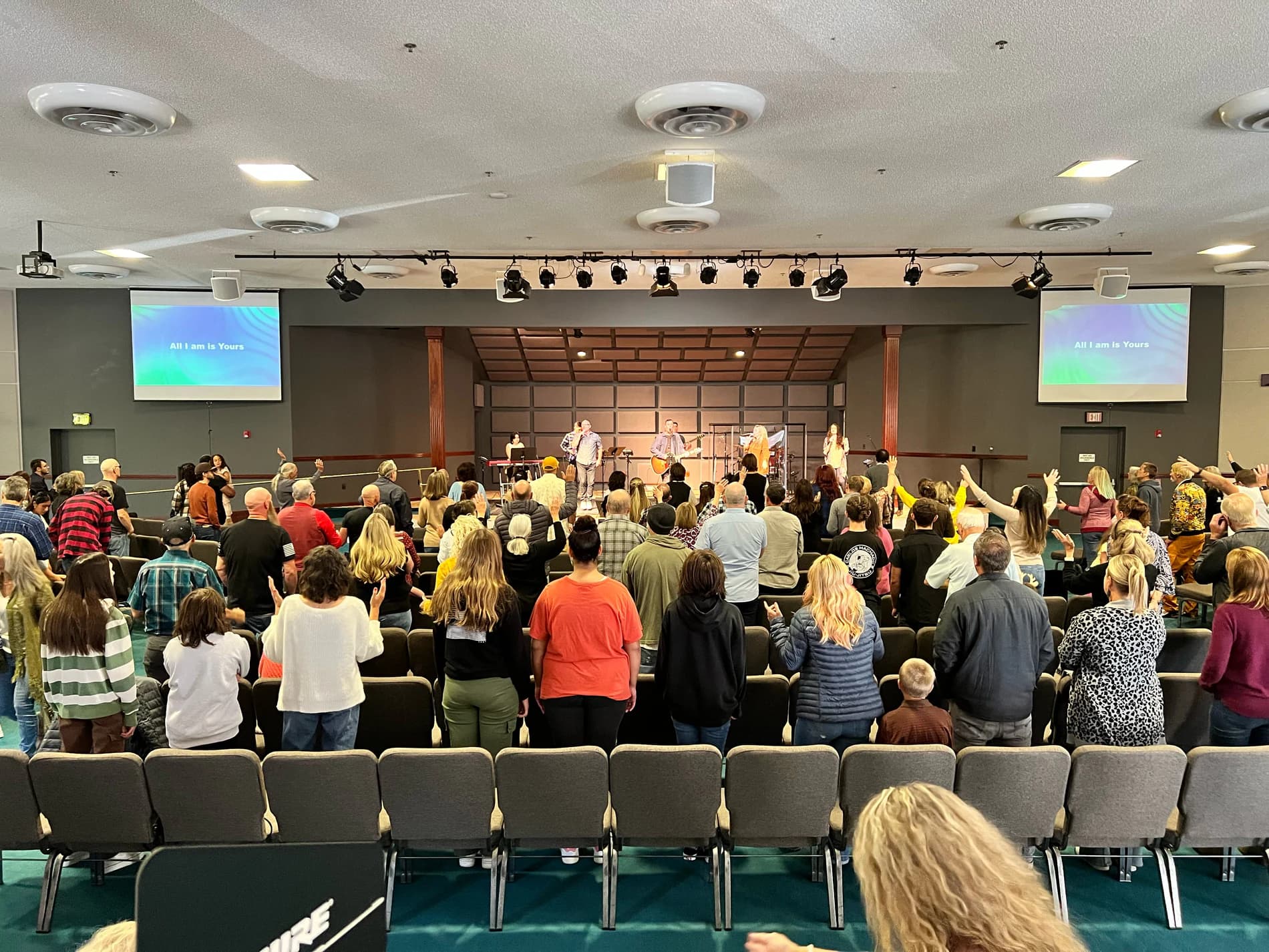
The useful lesson is not that LED won twice. It is that the second room’s answer was a layout decision, not a brightness decision. A church that had only asked “LED or projector” would have arrived at the wrong wall.
Beyond the panels
What replacing projection involves
A projector hangs from a mount and needs power and a signal. An LED wall is closer to a piece of the building. Structure carries real weight, panels draw meaningful current, processing has to match the sources the church already uses, and every module needs to be reachable when one eventually fails.
This is why panel price is a poor proxy for project cost. On the LED projects Qohr has installed, structure alone is frequently 3 to 16 percent of the total before processing, power, data, or labor.
Budget
What the switch actually costs
Qohr’s published planning examples range from $16,000–$31,000 for a 4–12 m² small or auxiliary wall to $42,000–$49,000 for a 12–23 m² sanctuary wall at 2.6mm. A 23–32 m² single-wall example is around $68,000, while multi-wall examples range from $91,000–$187,000. These describe installed project scopes, not panel-only prices. These are project planning examples, not fixed packages or prices per square meter. The area bands overlap at 12 and 23 m² because size alone does not set the scope. Confirm inclusions in your proposal: electrical and data coordination does not mean all local trade work is included, and shipping, travel, tax, and site preparation must be identified separately.
When the display is part of a wider audio, video, and lighting build, compare the combined scope rather than adding separate equipment budgets together.
Those figures are ranges, not quotes. A number given without seeing the room, the first-row distance, the structure above the stage, and the way the church actually runs a service is a guess wearing a decimal point.
Before you decide
Questions worth answering first
- When exactly does the current display fail: during a dark service, with the lights up, or on camera?
- Is the problem the same in every seat, or only some of them?
- How close is the first row, and how far is the last?
- Will this display be seen on a stream or recording?
- Is the stage lighting likely to get brighter in the next few years?
- What is above the stage, and what can it carry?
- Does the platform need to stay visually open?
- Who operates it on a Sunday, and what do they use now?
- How will a failed module be reached and replaced?
- Is the display genuinely the weakest part of the room?
FAQ / Straight answers
LED wall vs projector questions
Not always. An LED screen holds brightness with stage lighting up and reads better on camera, which is why most churches replacing projection are solving a brightness or livestream problem. Projection still makes sense in rooms with controlled lighting, at modest display sizes, when the church does not stream, or when an existing system is working and the budget is better spent elsewhere.